
How to Review a Losing Trading Day Without Rewriting Your Strategy
Product research based on TDLab workflows, hands-on testing and cited source material.
To review a losing trading day, first end the session, reconstruct the trade sequence from objective records and classify every trade as a valid process loss, a rule violation or unknown. Then find the first point where the process changed, compare what followed with your baseline and choose one action justified by the evidence.
Do not begin with "Why did I lose?" That question encourages the result to judge the decision. Begin with "What did I plan, what did I do and when did those two first diverge?"
The rule for red-day reviews
Preserve valid losses, expose profitable violations and leave unknown decisions visible. The review is accurate only when P&L cannot change the classification.Why a losing day distorts the review
Outcome bias occurs when the known result changes how a decision is evaluated. A recent replication of classic outcome-bias research found that people gave different quality ratings to decisions with different outcomes even when the decision information was held constant. The replication and its limitations are useful context for why a red day needs a fixed review process.
Trading adds another complication: behavior may change after a loss. Research on professional traders has documented increased risk after earlier losses in a specific market setting, while other work shows that realized and unrealized losses can produce different risk responses. The lesson is not that every loss causes revenge trading. It is that the sequence after the loss deserves direct inspection.
See the studies by Coval and Shumway and Alex Imas for the distinct contexts behind those findings.
1. End the session before explaining it
Confirm that open risk is handled, cancel stale orders and step away from execution. A review performed while searching for another entry is still part of the trading session. Record the time you stopped and whether a personal or account loss limit was reached.
If you are too activated to classify decisions consistently, do only the safety and data-capture pass. Save interpretation for a scheduled time later that day or the next morning. Delay is useful when it improves consistency, not when it becomes avoidance.
2. Reconstruct the timeline from facts
Build one chronological sequence from broker or platform records. For every trade, capture entry and exit time, setup, planned risk, actual size, net result, plan adherence and the gap since the previous exit. Include cancelled or rejected orders only when they affected the next decision.
Mark these anchors:
- the first loss of the session;
- the first rule violation or unreviewed decision;
- any increase in size or trade frequency;
- the first trade outside the intended setup or session;
- the point where the day's loss accelerated;
- the moment trading actually stopped.
Use observable language. "Entered four minutes after the prior loss with 1.5 times normal size" can be checked. "Lost control" cannot.
3. Classify each loss before looking for a lesson
Use only three review states:
- Valid process loss: the setup, risk and execution followed the written plan, but the trade lost.
- Rule violation: an observable part of the plan was broken, regardless of whether the trade won or lost.
- Unknown: the plan was ambiguous or the evidence is incomplete, so the decision cannot be graded honestly.
Do not invent a mistake to explain every loss. Valid losses belong in strategy performance. Violations belong in process performance. Unknowns belong in a data-quality queue until the missing information is resolved.
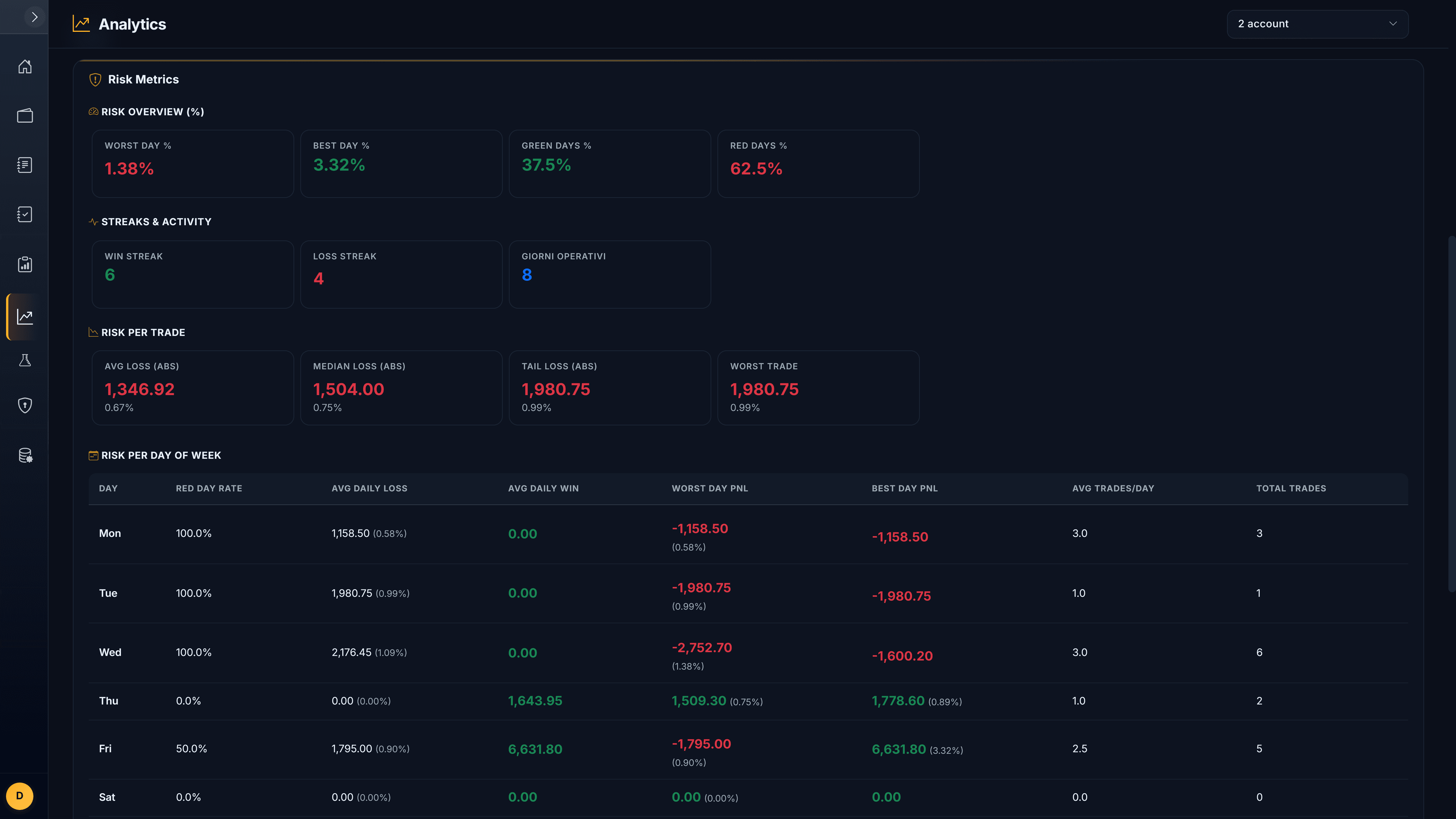
4. Find the first process change
Traders often focus on the largest loss because it dominates the outcome. The more useful review point may be earlier: the first rushed re-entry, skipped checklist, size increase or low-quality setup that changed the rest of the session.
Ask the sequence in order:
- What was the last clearly valid decision?
- What changed immediately after it?
- Was the trigger observable at the time?
- Which existing rule should have applied?
- Was the rule unclear, unavailable or consciously ignored?
A large final loss can be a consequence of an earlier process break. Fixing the first controllable change is usually more precise than writing a new rule for every later trade.
5. Compare the post-loss window with your baseline
Choose a stable definition, such as the next trade or the next 60 minutes after each loss. Compare that group with trades from similar sessions that were not immediately post-loss.
- time to the next entry;
- average size or planned risk;
- qualified-setup rate;
- plan adherence and execution quality;
- trade frequency and additional session drawdown;
- review coverage and unknown decisions.
Record these fields across multiple sessions in the free trading journal spreadsheet. A reusable sample makes the baseline comparison more credible than an isolated post-loss form.
Do not diagnose from one day
A single losing day can justify a safety action or reveal a clear violation. It rarely proves that a strategy, weekday or setup should be removed. Carry the hypothesis into a wider weekly sample.6. Choose the smallest justified action
Separate the action by time horizon. This prevents an urgent safety issue from becoming an untested strategy rewrite.
Immediate correction
Fix missing trades, incorrect fees, open risk or a breached hard limit. Preserve screenshots and notes that will disappear.
Next-session operating rule
Choose one action under your control, such as a 30-minute pause after a loss, normal-size confirmation or requalification against the same setup checklist. Write it as an if-then instruction.
Weekly-review hypothesis
Carry broader questions into the weekly trading review: does post-loss size repeatedly increase, does one setup lose its adherence late in the session, or does the day depend on one outlier?
7. Define restart criteria before the next session
A restart decision should depend on process readiness, not on a need to recover the money. Before the next session, confirm that:
- the prior day's trades and fees are reconciled;
- each decision has a valid, violation or unknown state;
- the active loss and account limits are visible;
- one post-loss rule is written in observable language;
- the next qualified setup uses the normal entry criteria;
- the rule's review date or minimum sample is defined.
The daily trading journal routine handles the normal post-session handoff. Use the losing-day audit when the sequence needs deeper reconstruction.
A losing trading day review checklist
- End execution and record the actual stop time.
- Reconcile trades, fills, size, fees and timestamps.
- Classify every decision before judging the daily result.
- Locate the first process change, not only the largest loss.
- Compare the post-loss sequence with a relevant baseline.
- Separate immediate safety actions from strategy hypotheses.
- Write one next-session rule and one review condition.
- Carry repeated patterns into the weekly review.
Common questions
Should I stop trading after one losing day?
Follow any pre-existing account or personal loss limit. Outside those limits, one losing day alone does not establish a universal stop period. Use defined restart criteria and the severity of any process breach rather than the urge to recover or avoid the result.
When should I change the strategy?
Change strategy rules when a suitable sample, reviewed under consistent definitions, supports the change. A single day can expose an ambiguity or violation but is usually too narrow to establish that the underlying edge has disappeared.
What if all trades followed the plan and still lost?
Record them as valid process losses. Confirm that the total risk stayed within the plan, then evaluate the strategy over its intended sample. A clean red day can be painful without being a process failure.
Connect behavior, context and performance.
TDLab connects your real trades with behavior, rules and historical market context, then helps you test what to change. Start free for 14 days.